
An interview with Pixel Park’s in-house Editor and Sound Designer, Ryan Gargac
Our Technical Director, Ryan, is a catch-all kind of creative. As are so many of our teammates. But he might take the cake! Ryan has an editing and animation background, and over the last decade has honed his skills as a sound designer and composer. He’s even released two personal albums in his time at Pixel Park.
Audio is often taken for granted, sometimes even misunderstood in video production, so we’re going to explore the ins and outs – how’s that sound?
For those of us who might not know, what exactly is sound design and why is it important?
A sound designer is often responsible for how music, voiceover, and sound effects are arranged and interact with each other. Sound designers may create custom sound effects known as “foley” (you may have heard this term in Hollywood) or use pre-recorded sound libraries. Much like visual design, sound helps to convey a feeling or desired tone for your audience. Hearing familiar sounds like nature, someone’s footsteps, or a car driving by can have a grounding effect for the viewer. It can even help you emphasize certain visuals on screen for added impact. BAM! WHOOSH! BING!
Sound design is like seasoning – can you imagine much flavor without it?
FAT Brands All Systems Go Conference Trailer with SFX
FAT Brands All Systems Go Conference Trailer without SFX
Watch the full FAT Brands Summit video here!
At what point in a project do you typically start thinking about sound design and music?
It’s a question best asked at the beginning of a project. If sound and music are an afterthought, then your audio could potentially fall more flat. If your project includes an animatic stage (this is when static art or sketches are placed for pacing), this is a great place to test out music and sound. A sound choice might influence the animation and/or timing of a scene. At this stage you might even decide that your video has a big moment where the voiceover cuts out and only music and SFX remain for that moment in time. Sound dramatic? It probably is!
An effective tool we learned to create from the extremely talented sound designer and musician, Ambrose Yu, is the music map. These maps can show visual learners how the audio will assist in telling the story. Music maps are particularly effective when you’re seeking to tell a strong emotional story. You can check out the one we used for our Pop Tab Heroes video for the Ronald McDonald House Charities.
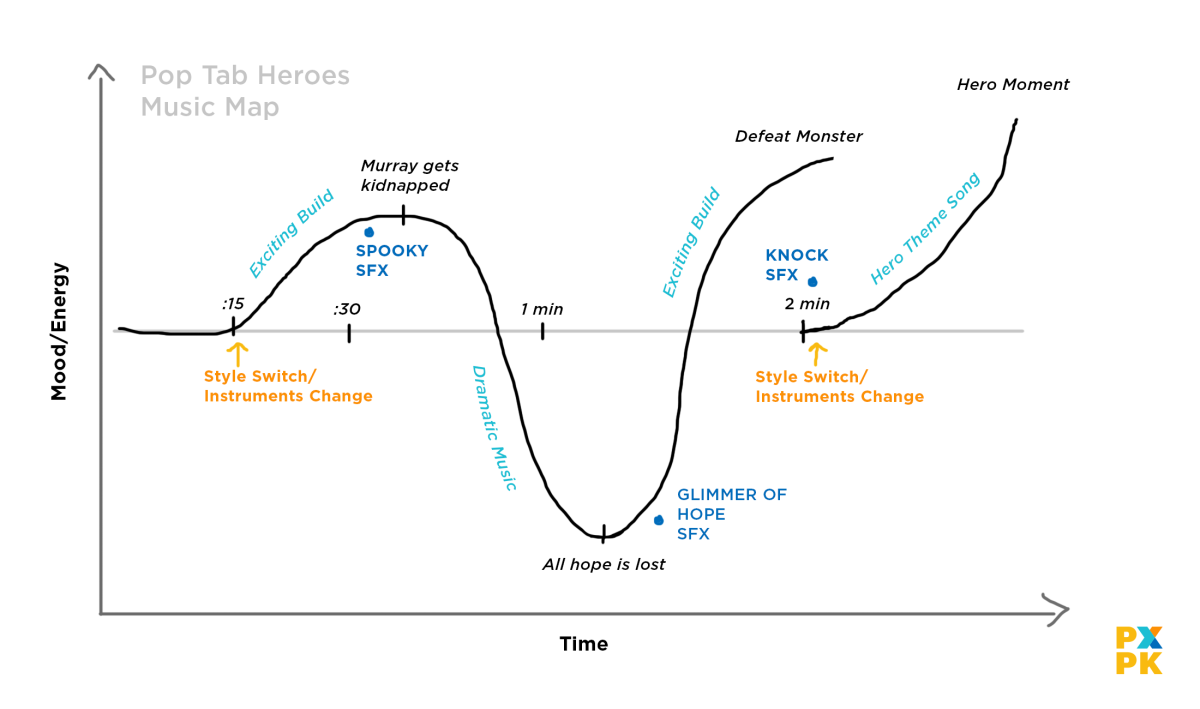
How can music impact the emotion of a project?
Music has so much impact! There’s a clip I saw floating around the etherweb’s of Darth Vader coming out of his ship while a general is waiting for him. Someone dropped in the classic “here’s a pretty girl/hunk music”, True by Spandau Ballet. And the vibe, the emotion, the story, really everything changes for the viewer. Can you imagine the Star Wars Opening Title without the GOAT John Williams’ Fanfare?
When I search for music for a project it tends to be an extensive search. I’ve even spent multiple days looking for the right music for a project, because it matters!


What’s the difference between stock and custom music? When should custom music be considered for a project?
Stock music is existing, purchasable music that lives in a library online. Sites like premiumbeat.com, marmosetmusic.com, & artlist.io provide stock music options. Some stock sites offer some customization ability which comes in handy. Working with the stems of a track gives you flexibility to turn on/off certain instruments depending on your needs or preferences. For example, if you have a very calm moment in your video you may want to mute everything besides the piano track. Or perhaps there is an annoying ukulele and clap within the song that you just want to remove all together. Yes – you can do that! And let’s be honest – the uke and clap combo fad died about 10 years ago.
When stock music doesn’t work for you, or if you can’t find the right song for your project there, custom music is always an option. Custom music involves a musician creating music completely from scratch and only for your use. While custom music costs more than stock, the end result is entirely tailored to you. Custom music allows for creativity with no boundaries. Additionally, music notes can be timed perfectly to accompany an animation or live action spot. And if there are revisions on the project, going back to tweaking the music is a lot easier. There’s a time and a place for custom music – and if you ask us, it’s always worth it.
How would you recommend brands and organizations think about sound design and music when they’re creating a video?
At Pixel Park one of our core values is “Create with Intention.” For brands and organizations alike, I recommend being intentional in the decision making process around audio.
Some questions to consider:
- What do you want the audience to feel?
- Does adding a sound enhance the story or message?
- What does your brand sound like?
- Does your brand have a consistent sound across marketing tactics that helps reinforce your brand identity?
- What is your budget? (Because yes – custom music is pretty much always going to be more expensive than stock.)
Do brands ever have a specific “sound”?
For sure! Of course a lot of brands have jingles that we all recognize. But some companies don’t even need to go for the full jingle. Take Honda for example, they just have two piano notes at the beginning of most of their ads. It’s subtle, but when you hear it you instantly know it’s Honda. Most of the time you don’t even realize they are doing it as a brand. It becomes subconscious. Likewise, before any Netflix show you watch you get the Netflix sound effect we all know and love.
So, what if a project doesn’t sound good?
Good quality audio matters. If you put all your effort into the visual story but neglect the audio, it can have major consequences. Imagine a brand hires a voiceover artist for their big national spot, but in an effort to save money they cut corners and record with a junky laptop microphone. When the ad airs there are few words that are hard to understand. Not only could this create confusion around the intended message, the audience might equate the bad audio quality with the company having a bad service or product. High quality audio means high quality brand perception – simple as that.
How do you prepare a video’s audio for different mediums like television or web?
Ever wonder why your favorite program was interrupted by a commercial that was toooooo loud? There’s a good chance the sound person didn’t follow the broadcast specs correctly. Preparing audio for TV typically requires using a spec sheet provided by the media buy company. Most broadcast TV specs for audio vary from channel to channel, but as a general rule audio levels are not to exceed -12dbs. Additionally, keeping your volume -24LKFS integrated is recommended. (LKFS is just a fancy way of measuring how loud your sound is.) Is this pretty technical? Yeah. But it’s critical!

For web videos going to YouTube or another video platform, it’s generally recommended not to exceed -1db to -3db, with loudness measuring out around -14LFKS integrated. Though, this isn’t a hard and fast rule, and can vary from platform to platform.
A strong video partner will take a good look at best practices per use, including platform consideration.
Which video from your PXPK portfolio is your favorite in terms of sound?
“Light up Your Life” is my favorite audio project I’ve worked on. We worked closely with our client, Consolidated Cooperative, who trusted us to tell a heartwarming story about how light touches each and every one of our days. I was given complete creative freedom to compose the music and sound effects. While the music is rather simple, I love how it changes from scene to scene to enhance the emotional tone of the story.
Doesn’t hurt that it won an AAF Addy Award for Sound. 😉